


Quality Standards for Toughened Glass: What Every Buyer Should Know
Introduction
Glass has become one of the defining materials in modern architecture. From elegant office partitions and storefronts to balconies, staircases, shower enclosures, and building facades, glass offers a perfect combination of style and functionality. However, not all glass delivers the same level of safety and performance. When it comes to structural applications, quality is just as important as appearance.
Toughened glass is manufactured to withstand higher impact, thermal stress, and daily wear than ordinary glass. Yet, these benefits can only be achieved when the product is manufactured according to recognized quality standards and undergoes rigorous testing. Understanding these standards helps architects, builders, interior designers, and property owners make informed decisions while ensuring long-term safety and reliability.
This guide explains the key quality standards, testing procedures, certifications, and factors that define premium toughened glass.
What Is Toughened Glass?
Toughened glass, also known as tempered glass, is produced by heating ordinary float glass to approximately 650°C and then rapidly cooling it using high-pressure air. This process creates compressive stress on the surface and tensile stress inside the glass, making it significantly stronger than standard annealed glass.
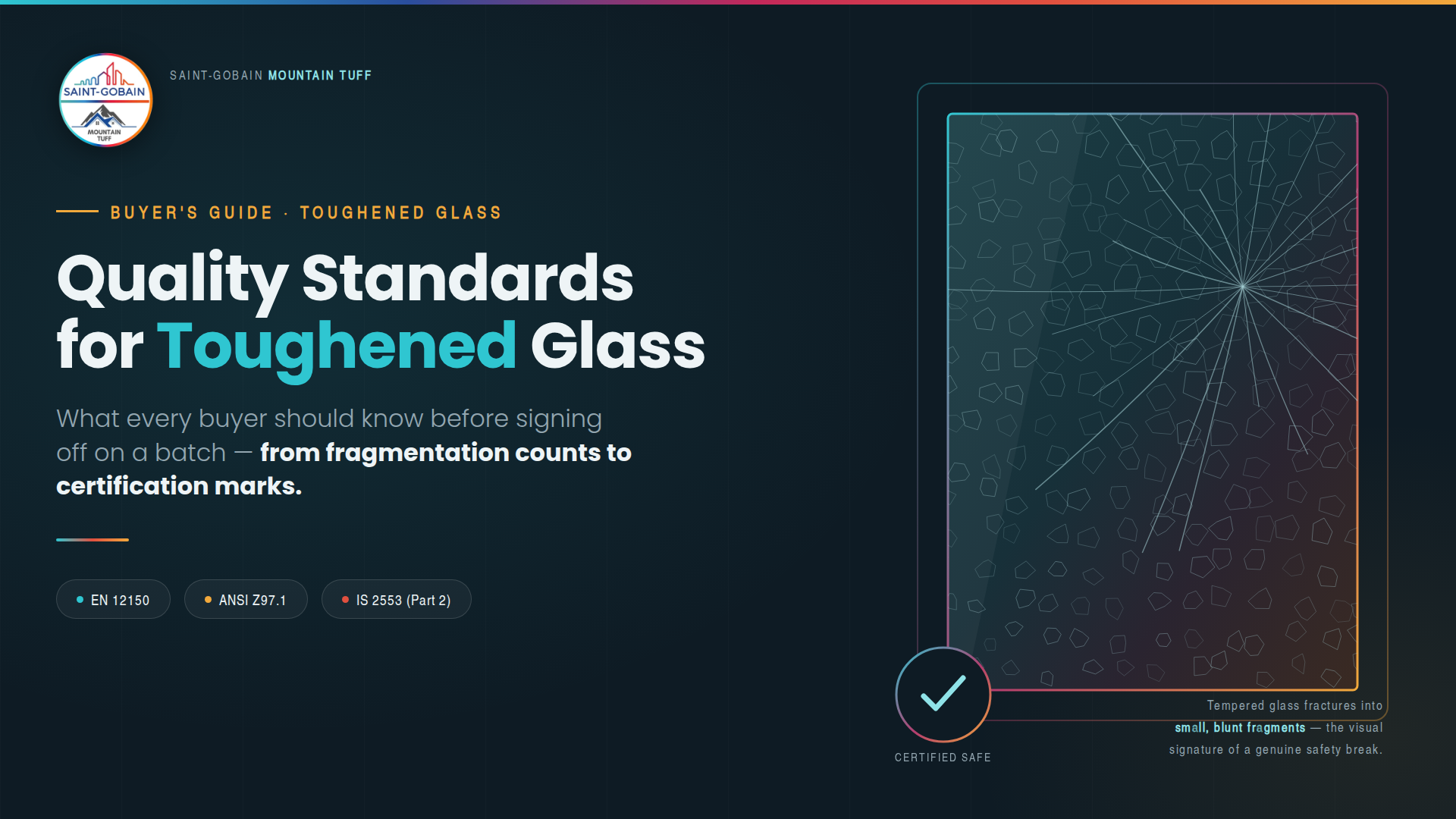
One of its most important safety features is the way it breaks. Instead of forming large, sharp shards, toughened glass shatters into small, blunt fragments that reduce the risk of serious injuries.
Today, toughened glass is widely used in:
- Commercial buildings
- Residential homes
- Office partitions
- Glass railings
- Shopfronts
- Shower enclosures
- Skylights
- Balconies
- Hotels and restaurants
- Educational and healthcare facilities
Why Quality Standards Matter
Quality standards are more than technical requirements—they ensure that every glass panel performs as expected under real-world conditions.
High-quality toughened glass offers:
- Improved occupant safety
- Better resistance to accidental impacts
- Higher thermal stability
- Longer service life
- Consistent appearance
- Reliable structural performance
Poor-quality glass, on the other hand, may contain internal defects, uneven stress distribution, or dimensional inaccuracies that increase the risk of unexpected failure.
Essential Quality Standards for Toughened Glass
1. Strength and Impact Resistance
One of the primary reasons for choosing toughened glass is its strength. Properly manufactured toughened glass is several times stronger than ordinary glass and can withstand significantly greater impact forces.
Manufacturers conduct impact resistance tests to verify that the glass performs consistently under different loading conditions.
2. Thermal Resistance
Temperature fluctuations are common in India’s climate. Glass installed in exterior applications experiences constant expansion and contraction due to heat and sunlight.
High-quality toughened glass is designed to withstand thermal stress without cracking, making it suitable for facades, windows, and exposed installations.
3. Surface Quality
A premium glass panel should have a smooth, clean, and uniform surface.
Quality inspection checks for:
- Scratches
- Chips
- Surface marks
- Air bubbles
- Foreign inclusions
- Roller wave defects
These imperfections not only affect aesthetics but may also reduce structural performance.
4. Edge Finish
The edges of toughened glass require special attention because damage often begins from poorly finished edges.
Proper edge processing includes:
- Smooth polishing
- Accurate grinding
- Uniform finishing
- Chip-free edges
Well-finished edges improve both safety and durability.
5. Dimensional Accuracy
Precision manufacturing ensures every panel matches the required dimensions.
Quality control verifies:
- Correct thickness
- Accurate length and width
- Uniform shape
- Proper squareness
- Consistent tolerances
This is especially important for commercial glazing and architectural projects.
6. Fragmentation Performance
One defining characteristic of toughened glass is its fragmentation pattern.
During testing, manufacturers intentionally break sample panels to verify that they fragment into numerous small, relatively harmless pieces instead of dangerous sharp shards. This confirms that the tempering process has been carried out correctly.
Testing Procedures Used by Manufacturers
Reliable manufacturers perform multiple quality checks throughout production.
Impact Testing
Impact tests evaluate the glass’s ability to withstand accidental force from everyday use and unexpected impacts.
Thermal Shock Testing
Glass is exposed to controlled temperature variations to ensure it can handle rapid heating and cooling without failure.
Optical Inspection
Advanced inspection systems check for:
- Surface distortion
- Visual defects
- Wave patterns
- Light transmission consistency
These inspections are particularly important for large commercial installations.
Dimensional Inspection
Every glass panel is measured to ensure compliance with specified dimensions before delivery.
Stress Analysis
Specialized equipment is used to verify that compressive stress is evenly distributed across the glass surface, ensuring maximum strength and reliability.
Industry Certifications That Build Confidence
Recognized certifications demonstrate that manufacturing processes follow established quality benchmarks.
Some important standards include:
Bureau of Indian Standards (BIS)
BIS standards provide guidance for safety glass used in buildings and help ensure products meet Indian quality requirements.
IS 2553
IS 2553 specifies performance requirements for safety glazing materials used in architectural applications.
ISO 9001 Quality Management
Manufacturers operating under ISO 9001 maintain structured quality management systems that emphasize consistency, process control, and continuous improvement.
Trusted Glass Brands
Many projects also specify premium glass supplied by globally recognized manufacturers, offering additional assurance regarding raw material quality and manufacturing excellence.
Signs of High-Quality Toughened Glass
Before selecting glass for any project, check for the following:
- Uniform thickness
- Smooth polished edges
- Clear surface without scratches
- Consistent transparency
- Accurate dimensions
- Professional packaging
- Proper identification markings
- Reliable certification
- Comprehensive quality inspection
These indicators reflect attention to detail throughout the manufacturing process.
Warning Signs of Poor-Quality Glass
Choosing low-quality glass may reduce initial costs but can lead to higher maintenance expenses and safety concerns.
Watch for:
- Rough or chipped edges
- Visible bubbles
- Uneven surface appearance
- Distorted reflections
- Scratches
- Lack of certification
- Inconsistent dimensions
- Poor finishing
Any of these issues may indicate inadequate manufacturing or quality control.
Choosing the Right Toughened Glass Manufacturer in Chennai
Selecting the right supplier is just as important as choosing the right product. An experienced Toughened Glass Manufacturer in Chennai focuses on quality throughout every stage of production, from sourcing premium raw materials to precision processing and final inspection.
When evaluating a manufacturer, consider:
- Years of industry experience
- Advanced tempering technology
- Comprehensive quality testing
- Skilled technical team
- Ability to handle custom projects
- Timely delivery
- Professional installation support
- Strong customer service
- Consistent product quality
A reliable manufacturing partner ensures that every project meets safety expectations while delivering lasting performance.
Applications That Depend on Certified Toughened Glass
Certified toughened glass is widely used across multiple industries because of its durability and safety.
Common applications include:
- Corporate offices
- Shopping malls
- Hotels
- Restaurants
- Hospitals
- Schools and colleges
- Residential villas
- Apartment buildings
- Airports
- Retail showrooms
- Industrial facilities
- Commercial facades
Each of these environments requires glass that can perform reliably under varying conditions.
Long-Term Benefits of Quality Toughened Glass
Investing in high-quality toughened glass provides long-term value through:
- Enhanced occupant safety
- Reduced maintenance
- Excellent durability
- Better resistance to weather
- Improved visual appeal
- Increased property value
- Compliance with industry standards
- Reliable long-term performance
Quality glass becomes a lasting investment rather than a recurring expense.
Conclusion
Toughened glass plays a vital role in modern architecture, combining safety, strength, and contemporary design. However, these advantages depend entirely on the quality of the manufacturing process and adherence to recognized standards.
Before selecting glass for any residential or commercial project, verify that it has undergone proper testing, meets applicable certifications, and comes from an experienced manufacturer with a strong commitment to quality. By choosing products that comply with established standards, you can ensure greater safety, improved durability, and dependable performance for years to come.
FAQ’s
1. Why are quality standards important for toughened glass?
Quality standards ensure that toughened glass delivers the required strength, safety, durability, and consistent performance in residential and commercial applications.
2. How is toughened glass tested?
Manufacturers perform impact testing, thermal shock testing, dimensional inspection, optical inspection, stress analysis, and fragmentation testing to verify product quality.
3. What certifications should I look for when purchasing toughened glass?
Look for compliance with BIS standards, IS 2553 requirements, and manufacturers operating under ISO 9001 quality management systems.
4. How can I identify premium-quality toughened glass?
Premium glass has smooth edges, accurate dimensions, a flawless surface, proper certification, and passes rigorous quality inspections before delivery.
5. Where is certified toughened glass commonly used?
Certified toughened glass is used in homes, offices, hotels, hospitals, shopping malls, educational institutions, commercial facades, railings, partitions, and storefronts where safety and durability are essential.


Add a comment